Train Ride
- 4.5
- Rating
- 1.00M
- Installs
- Free
- Price

 Analysis by App-foxy
I approached Train Ride expecting a light arcade game built around the simple pleasure of moving a train from one stop to another. That is exactly where its appeal lies: it takes a familiar vehicle, gives me passengers to deliver and missions to complete, and keeps the basic goal easy to understand from the first tap. It is not trying to be a detailed railway simulator, and I think that is important to understand before downloading it. This is a quick, accessible game from MTAG PUBLISHING LTD, aimed at players who want short bursts of train-themed action rather than a deep management experience.
After spending time with it, my view is fairly clear. The strongest part is the immediate loop: get the train moving, pay attention to the route and task in front of you, then try to finish cleanly. The weaker part is that the experience can feel narrower than the concept initially suggests. If you want a large railway network, complex scheduling or extensive customization, this is not the right destination. If you enjoy straightforward arcade challenges and like the idea of turning a train journey into a series of compact missions, it has a reasonable place on your phone.
How the train-focused arcade loop feels
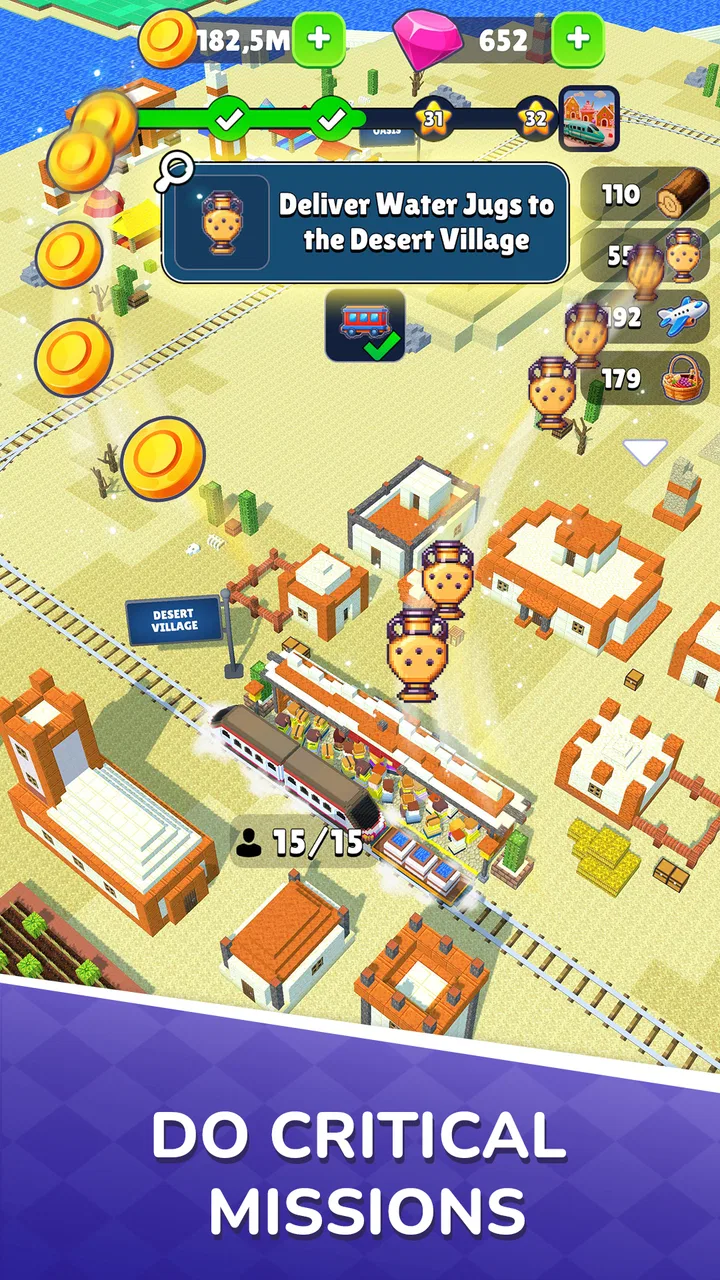
The game’s central idea is deliberately uncomplicated. I drive the train, carry passengers and work through missions that give each journey a little more purpose than simply moving forward. That simplicity makes the first session comfortable. I do not need to learn a long list of controls or understand a complicated economy before I can begin playing. The train is the focus, and the objectives give me a reason to stay engaged with each ride.
You May Also Like

 Blood Strike: 2.5 Anniversary
Blood Strike’s Loadouts Turn Every Drop Into a Tactical Gamble
A close look at Blood Strike’s custom loadouts: how fast access to signature weapons reshapes its battle royale rhythm, rewards preparation, and narrows the gap between fights.

 Pandora - Music & Podcasts
Pandora’s Music Is Easy to Start, but Harder to Recover
Pandora’s strength is its low-effort path from a seed to a station. Its weak spot is how much confidence it asks you to place in connection, setup, and quiet recovery.

 8 Ball Pool
 Is Built on Rivalries, Rematches, and Routine
A close look at the rivalries, rematches, shared routines, and unanswered safety questions that turn a quick pool match into a persistent mobile community.

 Samsung Music
’s Quiet Strength Is Playing What You Already Own
Its reach comes less from spectacle than from dependable access to a personal library. That simplicity is both the app’s strongest retention engine and its ceiling.

 AccuWeather: Weather Radar
AccuWeather Review: A Quick, Clear Forecast for Everyday Decisions
For everyday plans, the best forecast is the one you can understand quickly. AccuWeather makes rain timing, radar, and local conditions easy to act on, with a few trade-offs.

 Hill Climb Racing
Why Hill Climb Racing Still Turns Crashes Into One More Run
A tiny car, a bumpy hill and one more upgrade: Hill Climb Racing keeps resurfacing because its simple chaos makes every near-miss feel personal.
More From Our News Desk



That design also makes the game suitable for short sessions. I can imagine opening it while waiting for an appointment, taking a few minutes during a break or playing a little before bed without needing to reserve a large block of time. The missions provide a natural stopping point, which is more convenient than games that expect me to remain online or commit to a long round.
What I like most is the way the passenger-delivery idea gives the arcade format a small sense of responsibility. Even without turning into a full simulation, the train is not just a vehicle moving through an empty space. There is a basic purpose behind the journey. That purpose helps the game feel more directed than an endless driving toy, while still keeping the rules approachable.
At the same time, I would not describe the gameplay as a railway-management experience. Players who enjoy planning timetables, balancing routes, buying rolling stock or building a transport empire will probably find the focus too limited. Train Ride is better understood as a casual driving-and-mission game with a railway theme. That distinction prevents disappointment and makes its strengths easier to appreciate.
Why the missions matter more than the theme
The train setting is the feature that catches attention, but the missions are what keep the game from becoming repetitive immediately. A vehicle alone is not enough to support many sessions; I need a reason to care about the next trip. The objectives provide that reason by turning each ride into a small assignment rather than a free-form journey.
My advice is to treat every mission as a test of consistency instead of rushing through it. In an arcade game, the fastest route is not always the most comfortable one. I found it more useful to watch what the current task is asking me to accomplish, then make deliberate movements rather than treating every section as a race. That mindset is especially helpful when I am playing on a phone and my attention is divided.
A useful everyday scenario would be a short commute on public transport. I could play one mission with headphones off, keep the sound low and stop when I reach my destination. The game’s premise is easy to return to because I do not need to remember a complicated story or a large collection of characters. That makes it more practical for irregular players than a narrative game that loses its impact when played in scattered sessions.
There is also a small strategic trade-off in how I approach the missions. Playing cautiously may help me avoid mistakes, but it can make the experience feel slower. Playing aggressively may be more exciting, but it risks turning a simple objective into a frustrating restart. The best approach depends on whether I am trying to relax or improve my performance. That flexibility is one of the better qualities of the arcade design.
What works for new players
The accessible premise is a real advantage. Someone who does not normally play simulation games can understand the basic appeal immediately: control a train, transport passengers and complete the task. The age guidance is Everyone 10+, which fits the uncomplicated, family-friendly direction of the game while still leaving room for arcade challenges that may require patience and attention.
I also think the game is a sensible entry point for players who like vehicles but do not want the technical demands of a serious simulator. A train game can easily become intimidating when it introduces detailed controls, real-world procedures and lengthy explanations. Here, the concept is easier to approach. That makes it a better recommendation for casual players, younger users within the stated age guidance and anyone who wants a themed arcade game rather than a technical hobby.
New players should resist the temptation to judge the entire experience after only a few minutes. The opening idea is simple by design, and its enjoyment depends on whether the mission loop suits you. If you need constant novelty, the concept may feel modest. If you enjoy repeating a familiar action while gradually becoming more accurate, the straightforward structure can be relaxing.
One practical tip is to play the first sessions with the goal of learning the game’s rhythm rather than chasing perfect results. I found that focusing on clean completion made it easier to understand how much attention the game expects. Once that rhythm feels natural, I can decide whether I want to push harder or simply use the game as a calm time-filler.
The main limitation: a narrow promise
The biggest weakness is not that the game is simple; simplicity can be a strength. The issue is that the train theme may lead some players to expect more depth than the arcade structure offers. If I arrive looking for a detailed railway world, the basic mission-driven format may seem thin. The concept has room for imagination, but the experience is centered on immediate tasks rather than a broad simulation.
This matters because the usual alternatives in the category can offer different kinds of satisfaction. An endless runner may provide faster reflex challenges and more constant visual change. A conventional driving game may offer more familiar road-based variety. A management or simulation title may give me deeper planning and longer-term progression. Train Ride sits between those choices: it has the approachable action of a casual arcade game and the identity of a train title, but it should not be compared with a full railway simulator on complexity.
I also think repetition will be the deciding factor for many players. The core activity is focused, so people who enjoy mastering a repeated pattern may find that focus rewarding. Others may feel they have seen the main idea quickly. My recommendation is to consider how much you enjoy mission-based repetition before installing it. The game is not a poor choice because it lacks endless systems; it is simply more specialized than the train theme might suggest.
Another point to consider is the free-to-play structure. The game is free to download, but in-app purchases range from around five dollars to around twenty dollars per item. I would approach those purchases carefully and decide first whether the basic loop is enjoyable without spending anything. For a casual arcade title, paying should feel optional rather than necessary to discover whether the game suits me. Anyone managing a child’s device should also keep that purchase model in mind.
The current version is 0.14, so I would treat the experience as one that may still be developing. That does not automatically make it bad, but it does make my expectations more measured. I would not choose it because I expect a fully expanded railway universe; I would choose it for the focused activity it already presents. That distinction is especially important for players who prefer mature, feature-heavy games.
Who will get the most from it
I would recommend Train Ride first to casual arcade players who like vehicle themes and want an uncomplicated objective. It is a good fit for someone who enjoys checking off missions, improving through repetition and playing in short bursts. It may also appeal to families looking for a game with a train premise and an Everyone 10+ age guidance, provided an adult is comfortable with the presence of optional purchases.
It is also suitable for players who want a break from crowded competitive games. There is no need to approach it as a social contest or learn an elaborate meta-game before having fun. I can open it, focus on the current journey and put it away when the session ends. That low commitment is valuable when I want something more interactive than watching a video but less demanding than a long-form adventure.
Train enthusiasts should be more selective. If what attracts you is the atmosphere of rail travel, the satisfaction of route planning or the technical detail of operating locomotives, I would look toward a dedicated simulator instead. Train Ride may still be enjoyable as a lighter companion, but it should not replace a serious railway game. Its appeal is the arcade interpretation of the subject, not realism.
Likewise, players who need a large amount of content variety may be better served by an endless arcade title or a broader driving game. Train Ride’s identity comes from staying focused on the train-and-mission loop. That gives it clarity, but it also defines its ceiling. I would skip it if I already know that repeating a central activity quickly loses my interest.
How I would play it for the best experience
I would begin with short sessions and keep the goal modest: complete a mission, notice where control feels demanding and stop before the repetition becomes tiring. This approach makes the game easier to evaluate honestly. It also avoids the common mistake of spending money early in a free game before knowing whether its central loop has staying power for me.
I would also separate two kinds of play. When I want to relax, I would prioritize steady passenger delivery and treat the journey as a calm arcade task. When I want a challenge, I would replay with more attention to efficiency and precision. Switching between those mindsets gives the same basic structure two different uses and helps prevent the game from feeling like a single-note experience.
For a child or younger player, I would make the purchase settings clear before handing over the device. The age guidance makes the game approachable, but the optional items still deserve the same practical attention as purchases in any free mobile title. That is not a criticism unique to this game; it is simply part of using it responsibly.
I would install it on a compatible device running Android 7.0 or later. The game has passed the point where it is an obscure experiment: it has more than half a million installs, a sign that the concept has reached a meaningful audience. Still, its average rating is around three stars from roughly a thousand ratings, so I would read that as a reason to keep expectations balanced rather than assuming universal appeal.
What the audience response suggests
The rating tells me that Train Ride is likely to divide players according to what they expect from a train game. People seeking a quick arcade activity may appreciate the directness, while those expecting a richer simulator may be less satisfied. I find that useful context because a middle-of-the-road score does not necessarily mean the game is unplayable; it often means the match between the player and the design matters a great deal.
The number of written reviews is around a hundred, which gives the game enough public discussion to show that it has attracted genuine attention without making it seem universally established. I would use that alongside my own priorities: do I want simple missions, or do I want a detailed railway system? The answer matters more than the store presence or the train theme alone.
In my case, the game works best as a compact arcade diversion. I like that the premise is clear and that I can understand the purpose of a session quickly. I am less convinced that it offers enough breadth for someone who wants a long-term railway hobby. That is a fair trade-off, but it should be stated plainly.
My verdict after weighing the trade-offs
Train Ride is a focused, free arcade game with a pleasant central idea and a clear audience. I enjoy the uncomplicated rhythm of taking control, carrying passengers and working toward the current mission. It is easy to recommend when someone asks for a train-themed game that can be played casually without the weight of a full simulation.
My reservation is that the same focus can become limiting. The game will not satisfy every player who arrives because of the railway theme, especially anyone hoping for complex operations, broad customization or the depth of a dedicated simulator. The optional purchase range also means I would test the free experience carefully before considering any spending.
For me, the final judgment is a qualified recommendation: choose it for short arcade sessions, not for a complete railway simulation. It is best for casual players, mission-focused gamers and people who enjoy improving at a compact activity. If that sounds like your style, the straightforward design is its strongest asset. If you want a larger world and more systems to manage, another category of train game will serve you better.
Overall, I see Train Ride as a modest but understandable mobile game rather than an ambitious railway substitute. Its success depends on accepting what it is. With the developer listed as MTAG PUBLISHING LTD, a free entry point and a train-centered mission loop, it is easy to try. I would keep my expectations realistic, play without rushing into purchases and decide based on whether the repeated journey itself remains enjoyable. For the right player, that can be enough.
FAQs for Train Ride
01What is Train Ride, and how does it work?
Train Ride is an immersive simulation game available on Android and iOS, where players manage and operate their own virtual train network. The game allows users to design routes, upgrade trains, and transport passengers or cargo across various landscapes. With realistic graphics and engaging gameplay, it offers a unique experience for train enthusiasts.
02Is Train Ride free to play, or does it require in-app purchases?
Train Ride is free to download and play, offering a wide range of features at no cost. However, it includes optional in-app purchases that enhance the gaming experience, such as premium trains, advanced routes, and special customization options. These purchases are not mandatory to enjoy the game.
03What are the system requirements for installing Train Ride?
Train Ride requires a minimum of Android 5.0 or iOS 11.0 to function smoothly. The game is optimized for both smartphones and tablets, but having a device with at least 2GB RAM and a powerful processor is recommended for the best graphics and performance. Ensure ample storage space for additional updates.
04Can Train Ride be played offline, or is an internet connection necessary?
Train Ride can be played both online and offline. While an internet connection is required for certain features like leaderboards and multiplayer modes, the core gameplay experience, including route creation and train management, can be enjoyed without an internet connection. This makes it convenient for on-the-go gaming.
05Are there any parental controls or age restrictions in Train Ride?
Train Ride is designed for all ages, but it is particularly suitable for players aged 10 and above due to its strategic elements. The game does not contain any inappropriate content. Parents can use device-level parental controls to manage in-app purchases and screen time, ensuring a safe gaming environment for younger players.
Pros
- Immersive graphics enhance gameplay experience.
- Offers a variety of challenging levels.
- Simple controls make it easy for beginners.
- Regular updates introduce new features.
- Multiplayer mode adds competitive fun.
Cons
- Requires constant internet connection.
- Can be resource-intensive on older devices.
- In-app purchases can be costly.
- Occasional bugs disrupt gameplay.
- Limited offline features available.

Train Ride
Gallery